
Reflections so far!
FMF

I study Physics out of curiosity and in pursuit of understanding the fundamental principles that govern our Universe. The second law of thermodynamics, which tells us that systems naturally move toward disorder (entropy), mirrors how organizations grow and face complexity.
This concept, first articulated by Sadi Carnot in the 19th century and later expanded upon by Rudolf Clausius and Ludwig Boltzmann, illustrates that as systems increase in size and diversity, they inevitably encounter greater challenges in maintaining order.
This feels true the more I observe businesses, teams, or even crypto communities. It’s not something you immediately notice when a small team works together: Communication flows, decisions get made quickly, and everyone seems to know their role.
But as the group expands, something starts to shift — it’s like watching a system unravel, or watching how a blockchain network clogs up as transactions surge (we’re not going to discuss the technicalities here but if you want deep dive, I wrote a bunch about it in my prev blog post or vitalik post or others alike).
In crypto, I've seen projects that start with clear goals, a tight-knit team, and a focused roadmap (they often have had whitepapers). Then they grow, bringing in more contributors, investors, and users.
You’d think the added resources and brains would make things smoother, but ironically, the opposite happens. The more people involved, the harder it becomes to communicate. There’s an increase in communication inefficiency — longer discussions, misalignments, more stakeholders to consider — this is also known as the growth paradox.
When companies scale, they tend to create more processes to deal with the growing complexity, adding layers of management, rules, and meetings. They think they’re maintaining order, but in reality, they're making things more chaotic. It reminds me of crypto communities where governance aims to "decentralize" decision-making. But instead, they end up with fragmented discussions, decision paralysis, or a power vacuum.
I’ve experienced it; witnessing and getting caught up in the confusion that often arises when people try to navigate the crypto world without a clear understanding of its organizational structure — which I further outlined in my previous post.
It’s somewhat similar to the tech: Scaling brings more nodes, more participants, increase param, and that’s where the inefficiencies start to creep in (again I’ll give credit to Vitalik for his piece titled: the limits to blockchain scalability).
Think of it like a gas where molecules collide more frequently as the system becomes more energetic. With each interaction, there’s more room for friction and loss of energy, or in this case, miscommunication.
Consider Sam Altman's recent announcement about Mira's departure from OpenAI—made public on the same day she informed the company and its CEO. In any well-organized structure, major exits like this are typically communicated in advance? giving the organization time to prepare for the transition.
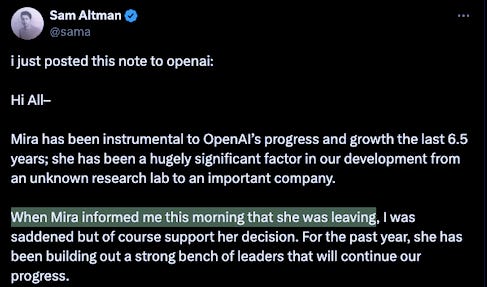
But here, the last-minute nature of her resignation brings to light the inherent communication inefficiencies that grow alongside organizations. I don’t want this to be controversial or something of that sort. I’m sure they have a reason — everyone has.
“War is what when language fails” as Margaret Atwood puts it.
At its core, war represents a situation where dialogue, negotiation, and understanding cease to function, leading to violence as a means of resolving differences. I understand this is just one piece of the puzzle (I am just oversimplifying the super complicated topic of War just to fit it into my narrative).
When two parties reach the point of war, it's not just a failure of diplomacy; it’s the collapse of communication itself. Language — the tool we rely on to bridge gaps, express needs, and resolve disputes — becomes inadequate. Instead of finding common ground through dialogue (diplomacy), both sides turn to violence, where brute force replaces reason. It’s the ultimate breakdown of trust, cooperation, and understanding.
Instead of bullets, how about we launch a meme attack? yes, I know this is not a serious blog post, I am just open-sourcing my thoughts — nukes don’t care about our opinions anyway.

Another piece to this is management. Crypto DAOs (Decentralized Autonomous Organizations) often struggle with managing growth effectively. Smaller DAOs might run smoothly with everyone involved.
But as they grow, they lose their agility, much like how a startup turns into a sluggish giant, slowed down by meetings, event coordination, approvals, paperwork, etc. It’s as if the original energy and creativity drain away as entropy (disorder) sets in.
And there’s the tricky balance between seeing the benefits of expansion (scaling) and missing the hidden costs. When crypto projects add new features or bring in new users, the immediate benefit is obvious—more buzz, more investment, or a bigger community.
But they often miss how this expansion adds complexity. It’s not always easy to see how that complexity will backfire until the communication falls apart or the project loses focus.
Organizations, Like Living Systems, Need Energy To Survive
In the crypto world, this vital energy comes from clear direction, strong leadership, and community alignment. Without these essential elements, organizations can lose their purpose and coherence, much like a disassembled automobile loses its functionality (I reference automobile and crypto here because I’m familiar “not expert” with how the system works).
Complexity is a double-edged sword. On one hand, complexity can drive innovation, growth, and adaptability. As organizations or systems scale, they often need to diversify roles, create new structures, and introduce specialized processes.
On the flip side, too much complexity often leads to inefficiencies, communication breakdowns, and a loss of agility: they start creating more layers of management, endless workflows, and unnecessary processes that make decision-making slower and harder.
The more people you add, the more processes you introduce, the more the machine starts to grind. The communication slows down, the direction becomes unclear, and what was once a fast-moving, agile project turns into a bloated mess.
A few notable examples in crypto:
Ethereum Initially launched with a clear vision for smart contracts and decentralized applications, Ethereum has struggled with scalability as its popularity surged. The introduction of complex solutions like sharding and Layer 2 scaling (e.g., Optimistic Rollups) has led to confusion among developers and users, complicating the ecosystem rather than simplifying it. The transition to Ethereum 2.0, aimed at addressing these issues, has also been delayed multiple times, further complicating the roadmap and frustrating the community (back in the day).
Ripple started with a straightforward goal of facilitating cross-border payments but became entangled in regulatory complexities and legal battles with the SEC over its status as a security. This situation has created uncertainty around its operations and future growth, leading to confusion among investors and users about its viability
Gnosis aimed to create a decentralized prediction market platform but faced challenges due to its complex architecture involving multiple components like Gnosis Safe and Gnosis Protocol. This complexity made it difficult for users to navigate and engage with the platform effectively, leading to lower participation rates than expected.
Waves was designed as a platform for creating custom tokens easily. However, as it expanded its features—like decentralized exchanges and smart contracts—the additional complexity made it harder for new users to understand and utilize the platform effectively. This resulted in slower adoption compared to simpler alternatives…. and many others and yet to be.
It’s the same issue you see in traditional organizations. I can’t help but relate it to the second law of thermodynamics again — systems naturally move toward disorder, and the bigger they get, the harder it is to keep them running smoothly. The more pieces you add to the puzzle, the more chances there are for things to go wrong.
The Answer To This Instead Of Fighting Complexity With More Complexity, You Fight It With Simplicity — And It’s Easier Said Than Done.
less is more
First, keep the structure lean. If everyone knows exactly what they’re responsible for, there’s less room for misunderstandings. You don’t need layers of middle management or endless committees to make decisions. Think of it like a smart contract — it does one job and does it well. Planning for talent is important (the right people), sure, but over-engineering the organization with too many roles or processes just creates inefficiency. Focus on clarity — make sure everyone knows what’s expected of them and where they fit into the bigger picture.
This is like that viral video of the biker in Italy. One biker broke the norm and outpaced everyone. By reducing drag, he moved faster with less effort — it’s all about physics babe. Similarly, organizations that eliminate unnecessary complexity can potentially move faster and outpace the competition. It's all about understanding the system and finding the leverage point that creates speed and efficiency.
Next, streamline processes. It’s tempting to add new workflows or systems as problems come up, but that only makes things more complicated. Instead, make the existing processes more efficient. Collaboration should be frictionless, not slowed down by unnecessary steps.
Finally, set up a simple operating system (right culture). Every organization needs a way to keep track of goals, progress, and communication, but that doesn’t mean it has to be complicated. Regular showing up, clear KPIs, and simple communication protocols are enough to keep things running smoothly — above all get things done.
The core of it all is this: growth doesn’t mean you have to add complexity. In fact, the best way to manage growth is by keeping things as simple as possible. Less is more. When you boil everything down to what’s essential — lean structure, efficient processes, and simple operational management — you avoid the entropy that derails so many projects. Crypto and corporate structure just like any system, thrives on clarity and efficiency.
Systems thinking is a discipline for seeing wholes. It is a framework for seeing interrelationships rather than things, for seeing patterns "of change" rather than static "snapshots". -Sir Peter Senge