The End of the Beginning
My Crypto Journey Reality Check

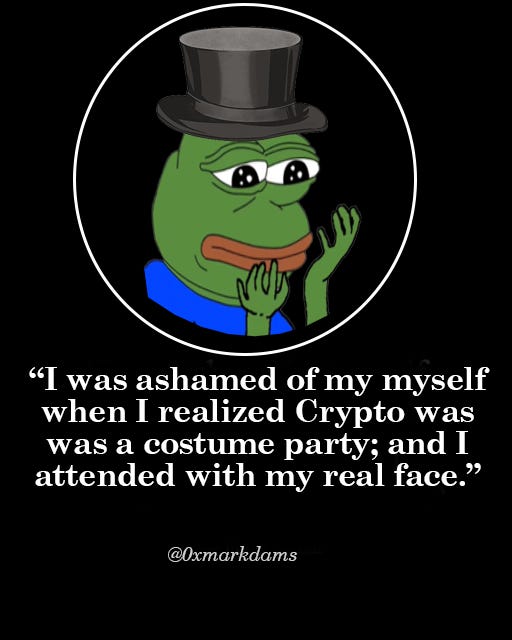
“I was ashamed of myself when I realized that crypto was a costume party, and I attended with my real face”
I had approached the space with excitement, clear intention, and reason (or simply “free will” is just an illusion): believing in its promise of decentralization, meritocracy, and freedom from the gatekeepers that plagued so many traditional industries.
But what I found, after some time, was that even in this space, supposedly mitigate those problems — the same dynamics of power and favoritism prevalent in traditional industries were at play, often masked by new gatekeepers wielding influence through wealth and connections or just because they are here first.
It was (still is) challenging (in a good way, “Pathemata Mathemata”). I had entered crypto with the belief that this was different. I wasn’t wearing a mask of pretense or joining in to play a role. I was genuinely excited about the potential possibilities of this technology and the entire industry as a whole.
But, I quickly encountered a landscape filled with immature, unserious individuals who often offered fake appreciation and superficial engagement.
I intended to contribute meaningfully, to learn, and to push myself forward and hopefully build something cool that I can be proud of — hopefully, add value to people. As I discussed this in my previous post (29 years of being Independent).
I thought the decentralized nature of blockchain would democratize opportunity. No more middlemen. No more gatekeepers blocking the door for anyone who didn’t fit their narrow criteria. Here, I imagined, it would be all about the merit of ideas and the strength of execution.
But I was naive and stupid. Crypto, like every other industry, still had its own gatekeepers. Sure, they looked different, often dressed in the language of decentralization, innovation, and freedom. These gatekeepers, often influential figures running these communities, operated with the same biases and self-interest that permeate other industries.

It wasn’t necessarily family ties here but rather access to insider networks, early involvement, or being part of certain exclusive groups. If you weren’t “in,” you weren’t part of the conversation. And even in this space, the powerful had their favorites, backing projects they liked for personal reasons.
I witnessed this dynamic reflected in the funding mechanisms for projects and in hackathons (which I'll discuss further later in this post) — not based on clear objectives (or public goods) or the quality of the technology (or work), but rather on “who knew whom”.
Many projects lacked genuine utility, offering no innovative concepts and simply “copy pasta” (Ma che vuoi?) others to chase quick profits. It wasn’t always about the best solution; it was about who had the right connections and who could play the game.
One recent example:
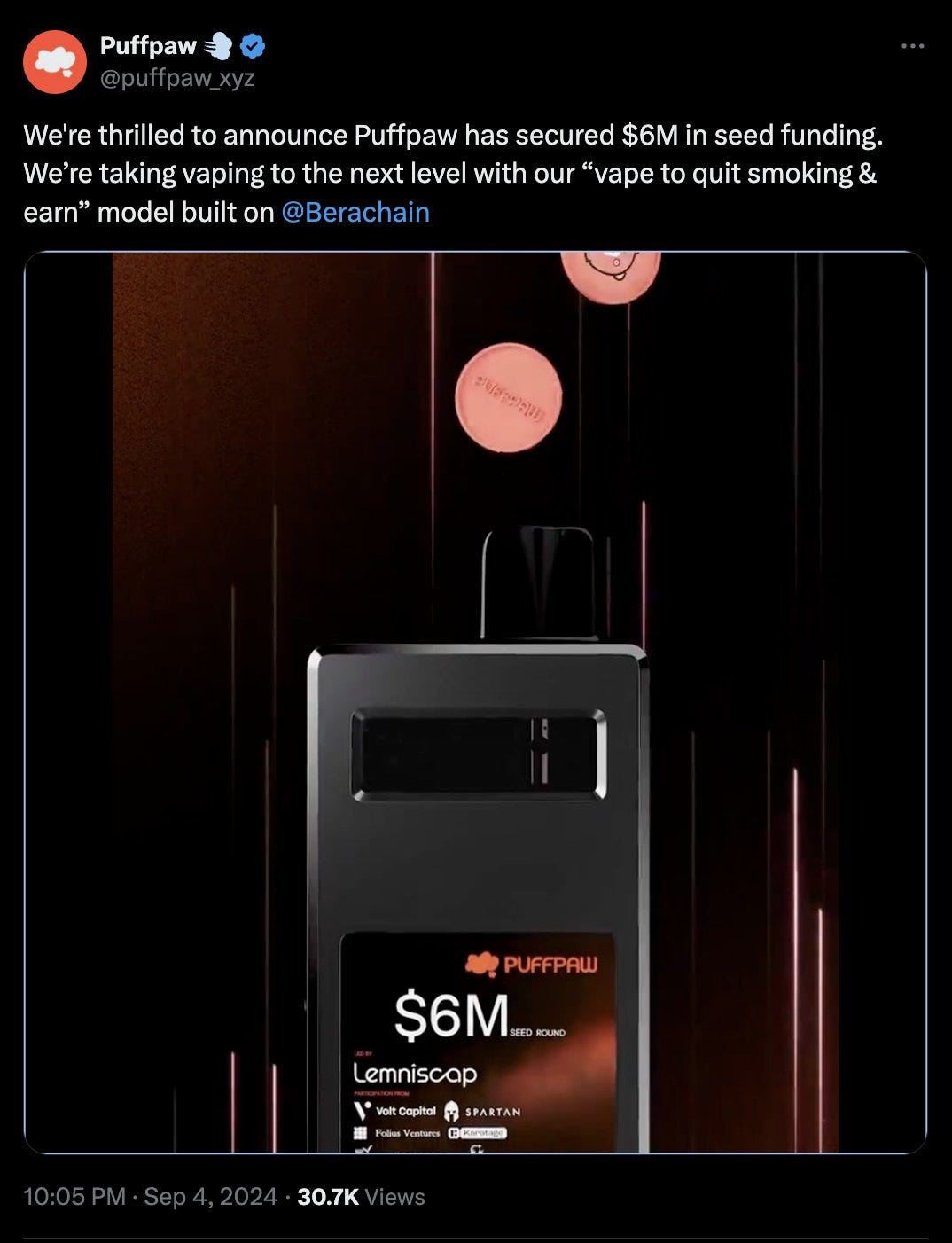
Just to be clear: I have no intention to discredit this project or its founders — sure they can have a high probability to onboard many users and make a tons of money especially in the vaping community with ~ 82M people but there is a concerning trend of individuals who have never smoked adopting unhealthy behaviors like vaping just to fit in or appear cool. Further, “Empirical research replicated findings from the U.S. in the Netherlands and Flanders found high school students who used e-cigarettes at baseline were more likely to report initiating combustible tobacco use”. And simply just my values are aligned with those of Kol in crypto, such as Cobie, Vitalik, Armani, Toly, and others alike, who advocate for transparency, accountability, public goods, and the long-term sustainability of the industry.
As envisioned by Satoshi and others alike, Crypto is: (a) decentralized, (b) trustlessness ie “Functions without the need for trust”, (c) transparency, (d) peer-to-peer ie “no middleman leads to low or zero cost”, (e) financially inclusive “trade across different jurisdiction”, (f) privacy, (g) borderless payments, (h) censorship-resistant, (i) open-source system that is permissionless.
In the end, It is a permissionless and censorship-resistant industry where anyone and have to freedom to build, regardless of the potential implication — some of which may be speculative or lack long-term viability. Survivorship or Herd mentality bias often comes into play, as successful projects are celebrated while failed ones are quickly forgotten — where people may blindly copy the strategies of successful projects without considering the underlying factors that contributed to their success.
There are no solutions. There are only tradeoffs. - Thomas Showel
My approach, however, is to focus on what might potentially work for me that aligns with the abovementioned essence of crypto rather than just following the crowd. Personally, I believe it's best to concentrate on your own path and not worry about others' strategies MYOB (mind your own business).
Are we still that early? In every complex system, there’s always a parasite — it’s given. These parasitic elements (eg. fraudsters, exploiters, corrupt, etc) thrive off the weaknesses and vulnerabilities of the system per se.
But I’m optimistic we can cope with this as the entire industry matures; therefore, with smart policy (objective referee), increased transparency, fair competition, and a collective commitment to ethical practices, we can create a more resilient system that minimizes opportunities for these parasites to thrive — otherwise, we’re more likely to be doomed.
Just to be clear: I have no issue with people making money in crypto —I mean, that's what we all came here for, right? — crypto, in essence, is just finance with additional perks and complex tech. My concern lies with grifters who create projects for the sole purpose of milking the public because I had experienced this horror myself way back.
The fundamentally flawed incentive model within crypto fuels this issue
Projects are often structured to reward short-term speculation rather than long-term value creation (positive sum). Early investors and insiders are incentivized to hype up their tokens, creating artificial demand, only to cash out once prices peak. This leaves retail investors holding the bag, chasing dreams sold to them by people wearing masks of innovation, while in reality, they’re just cashing out on speculation.
I had a direct and personal experience with this way back in 2018 (“SITG”) that I also shared it in my previous blog post.
In theory, the decentralized and permissionless nature of crypto should lead to more innovation and opportunities (which I’m optimistic about despite the noise).
But in practice, these incentives often distort that vision. Instead of rewarding those who build sustainable, valuable technologies, the system rewards those who can generate the most hype.
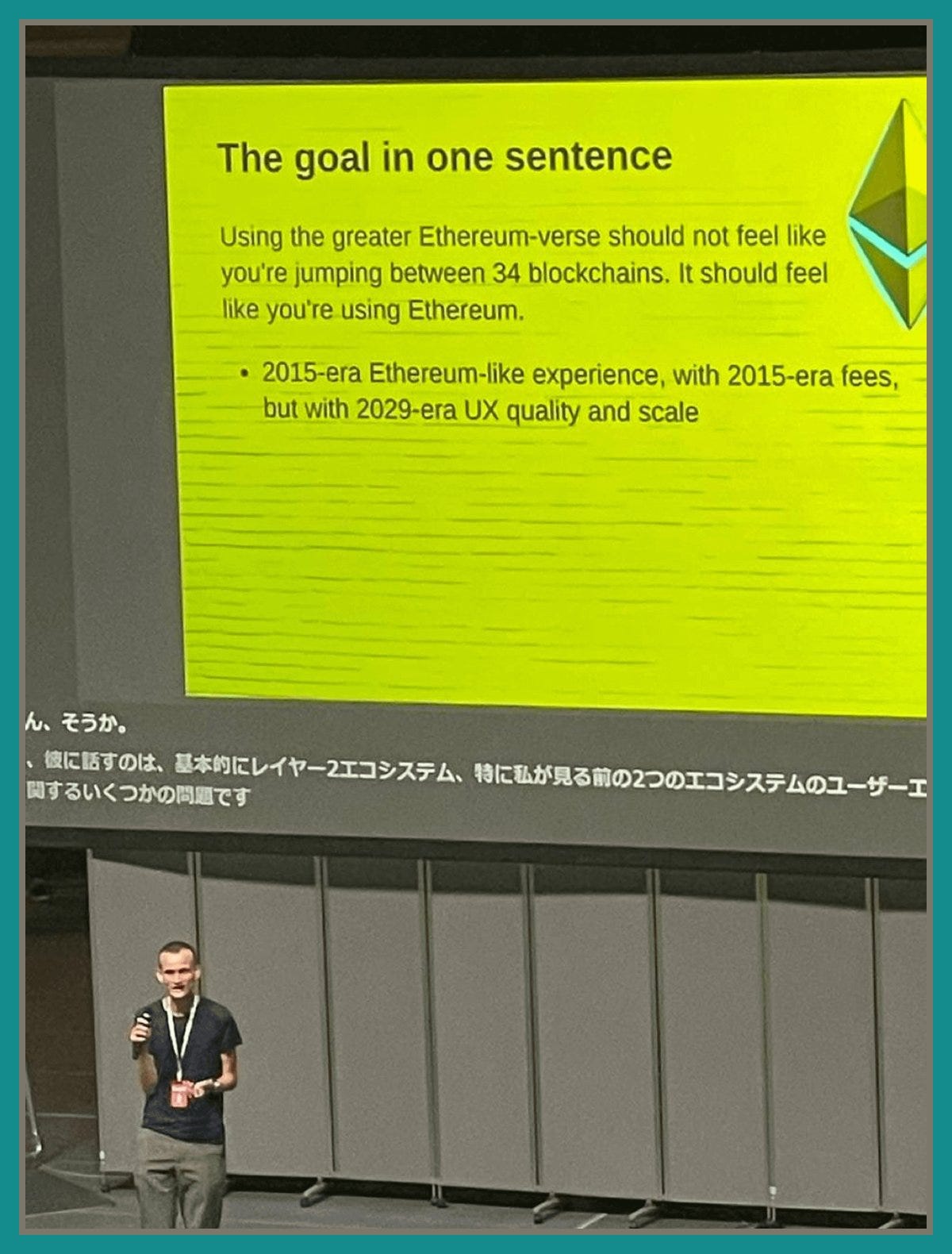
Adding to this distortion is the complexity of the technology per se. Different chains have respective consensus mechanisms → different architectures → different development techniques → different token standards introduce varying degrees of technical intricacies and incompatibilities.
Further, what should be a straightforward ecosystem is fractured by different tech stacks and semantic differences, making it harder for users and developers alike to navigate, collaborate, or build interoperable solutions.
I’ll give another + points to sir Vitalik for his goal:
And because success is measured in token price rather than real-world utility, projects often prioritize flashy marketing campaigns over meaningful development. The result is a market flooded with speculative ventures, many of which lack long-term viability.
I’ve seen promising projects (will not mention them here) get ignored because they didn’t have the right connections, while BS soared — backed by influential personalities. It’s the same story as everywhere else.
The hypocrisy was staggering. We were supposed to be breaking down walls, creating a new system free from the flaws of the old (trad). Yet, we were building new walls, often invisible but just as real, keeping out those who didn’t conform or play by the unspoken rules of the game. People spoke about democratizing finance but only to those they considered worthy — markets and time are the ultimate arbiters.
Leveling Up My WS with Hackathons
I built programs before my sales journey, I also shared this in my previous post, hacking 0’s and 1’s (and am currently refreshing my knowledge into systems, and network stack thanks to MIT OpenCourseWare and chatGPT). Most people think building software is all about coding but building “good programs” (that have a higher probability of success) requires a lot of thinking about what problems they want to solve.
It also involves design, finding the right people, testing, maintaining, etc. — Coding is the easy part, especially with the help of sophisticated AI tools that already exist today and I believe will continue to get better.
The hard part is building programs that people really want but to achieve this, you must first identify your target audience or users and how to onboard them. Therefore, this often requires extensive experimentation and iteration based on users’ feedback.
and you cannot or almost impossible to do it alone.
I participated in these Solana Hackathons (mostly writing content, research, analytics, and docs) hoping to earn some money to buy me M3 or any just better than my current Ryzen 3, this rhymes AF —but it’s true.
It's understandable to feel that participating in these hackathons is not always evaluated solely on their technical merits and user impact. due to the lack of transparency, their evaluation process can be influenced by:
Familiarity with the project team;
Evaluator's personal preferences, lacks objective;
Lack of standardized, transparent criteria
or simply relying on Flawed Checkers (eg. AI, plagiarism tools, or something of that sort) without truly understanding and reading the content.
What gets attention, what gets rewarded, often depends on who you know, not what you’ve built. This is just my mere observation and experience and I could be wrong I am just an idiot and ignorant. I'm aware that I may have limitations (skill issues or just simply genetics), but that is something I am committed to work hard on.
WHO AM I? — Nobody Cares
I fell in love with this Industry and I know it’s not perfect for what I thought it was. I have reasons (or just free will is a mere illusion) with a clear goal in mind or this could be the beginning of the end.
I’m just a nobody living in a developing country without Rich connections within Web3. The reason I wrote this blog post is to share my journey from different industries to Web3’s — nothing comes with ease.
I had so much Joy writing this because I noticed that my writing is improving — am determined to keep on learning. I've been writing for almost 4 years now, primarily reflecting on what I've learned in different subjects (eg. Bio, philosophy, physics, gen tech, human nature, etc) and I'm fairly new to crypto. Thank you to all the people who are being part or yet to become part of this journey).
You have to live life, regardless of the circumstances.
I could be wrong about all the things that I’ve said but willing to change when presented with better evidence or explanations.
People say build on the bear market, this is what I can build and try some on Devnet ATM, hoping to get feedback from like-minded individuals and have a meaningful conversation, collaboration, and connection.
I have no idea how to win this game, but I'm willing to keep playing for as long as the universe permits. There are still a lot of uncertainties and unknowns, and I don't have any idea what those unknowns are.
You might perceive me as having an ego, but honestly, I don’t mind. I'm not writing this to please anyone or fit into one's expectation — simply a reflection based on what I observed (observoor). That said, feel free to reach out to me on X (formerly Twitter) 0xmarkdams if this makes sense to you and would embrace substantial criticism.
I want to leave y'all a borrowed quote from Nassim Taleb (a person whom I deeply admire and respect as a scholar/intellectual) he puts:
“True humility is when you can surprise yourself more than others; the rest is either shyness or good marketing”
Everyone has an ego, it's just that people don't like those with a bigger one because it might disrupt their social harmony, cause social comparison and status threats, or make them feel insecure and people don’t like to be uncomfortable.
Thank you for reading may the bull market be with you —Just hold on and keep pushing forward.